
How to Use an AI Blog Writer to Grow Your Shopify Store in 2026
Content marketing is one of the most effective ways to drive free, sustainable traffic to your Shopify store. But most store owners never publish a single blog post because it takes too long, costs too much, or they simply do not know where to start. AI blog writers change that equation entirely.

If you run a Shopify store, you already know that paid ads are getting more expensive every quarter. Customer acquisition costs on Meta and Google have risen steadily, and the days of cheap clicks are behind us. Meanwhile, the stores that invested in content marketing years ago are now reaping the rewards of compounding organic traffic that costs nothing per click.
is what freelance writers typically charge per blog article. Agencies charge thousands per month. AI blog writers cut that to near zero.
The problem is that creating high-quality blog content has traditionally required either hiring a freelance writer at $100 to $500 per article, spending hours writing it yourself, or outsourcing to an agency that charges thousands per month. For most Shopify merchants, especially those running lean operations, none of those options are realistic on a consistent basis.
That is where AI blog writers come in. In 2026, a new generation of AI-powered content tools can generate well-researched, SEO-optimized blog articles in minutes instead of hours. Some are built specifically for Shopify, meaning they understand your products, your niche, and the keywords your customers are actually searching for. They can publish directly to your Shopify blog with a single click.
This guide covers everything you need to know about using an AI blog writer to grow your Shopify store: why blog content matters more than ever, how to choose the right tool, how to get started, and the best practices that separate stores that see real results from those that don't.

What Is an AI Blog Writer?
An AI blog writer is a software tool that uses large language models to generate blog articles based on your inputs. You provide a topic, a target keyword, or a brief description of what you want to write about, and the AI produces a complete article with headings, paragraphs, and structured content that is ready to publish.
Modern AI blog writers go far beyond simple text generation. The best tools for ecommerce integrate with your store data to understand your product catalog, analyze what keywords are relevant to your niche, and structure articles in a way that satisfies both search engines and human readers. They handle on-page SEO elements like meta titles, meta descriptions, header hierarchy, internal linking, and even generate cover images to accompany the article. To see how these content tools stack up against technical SEO options, read our roundup of the best SEO apps for Shopify.
For Shopify stores specifically, the most useful AI blog writers are those that plug directly into your store. Instead of writing content in a separate tool and then manually copy-pasting it into Shopify, a native Shopify blog app lets you generate, edit, and publish articles without ever leaving your admin panel. It can pull your product data automatically, embed shoppable links to your products within the article, and publish to your Shopify blog in one click.
The technology behind these tools has improved dramatically. In 2024, AI-generated content was often generic and easy to spot. By 2026, the best AI content generators for Shopify produce articles that read naturally, include specific and relevant details about your product category, and follow SEO best practices that would take a human writer significant time to implement manually.
Why Shopify Stores Need Blog Content
Many Shopify store owners think of blogging as something that media companies and lifestyle brands do. In reality, blog content is one of the most powerful growth levers available to any ecommerce store, regardless of size or niche. Here is why it matters in 2026.
Organic Search Drives Free, Compounding Traffic
Your Shopify product pages can only rank for so many keywords. A product page for "ceramic coffee mug" will target that exact term and a handful of close variations. But your potential customers are searching for hundreds of related queries: "best coffee mugs for keeping drinks hot," "ceramic vs stainless steel mugs," "gift ideas for coffee lovers," and "how to clean ceramic mugs."
Blog articles let you capture all of that surrounding search traffic. Each article targets a different keyword cluster, and each one becomes a new entry point to your store. Over time, this traffic compounds. An article published today might start ranking in three months and continue driving visitors for years without any additional spend.
This is fundamentally different from paid advertising, where traffic stops the moment you stop paying.
A store with 50 well-optimized blog articles can generate thousands of organic visits per month indefinitely. That is traffic you own, not traffic you rent.
AI Search Engine Visibility
In 2026, an increasing number of shoppers are using AI search engines like ChatGPT, Claude, Perplexity, and Gemini to research products before purchasing. When someone asks ChatGPT "what are the best running shoes for flat feet?" or tells Perplexity "find me an affordable standing desk," those AI tools pull information from published web content to formulate their answers.
Stores that have authoritative, well-structured blog content about their product category are far more likely to be cited and recommended by these AI tools. If your store has a comprehensive article about choosing running shoes for different foot types, you have a much better chance of being mentioned when an AI search engine answers that query than a store that only has product pages.
This is a new frontier for ecommerce, and most store owners have not caught on yet. The stores building a library of helpful content now will have a significant first-mover advantage as AI-driven product discovery continues to grow.
Building Topical Authority in Your Niche
Google's ranking algorithm increasingly rewards topical authority. This means that a store which publishes multiple articles covering different facets of its niche will rank better for all of those terms than a store that publishes a single article on each topic. The algorithm recognizes that you have deep expertise in the subject area and rewards you with higher rankings across the board.
For example, a store that sells yoga equipment and publishes articles about yoga poses for beginners, the best yoga mats for hot yoga, how to start a home yoga practice, yoga equipment maintenance guides, and yoga gift guides will build stronger topical authority than a competitor that only has product pages. Each new article reinforces the others, creating a content ecosystem that signals expertise to search engines.
Supporting the Full Buyer Journey
Not every potential customer is ready to buy right now. The buyer journey moves through stages: awareness (they realize they have a need), consideration (they research options), and decision (they are ready to purchase). Product pages serve the decision stage. Blog content captures customers at every other stage.
A "how to choose the right mattress" article captures someone in the consideration stage. A "signs you need a new mattress" article captures the awareness stage. Both of these readers might become customers, but only if you give them a reason to find your store before they are ready to click "add to cart." Without blog content, you are invisible to the majority of your potential audience until they have already narrowed down their choices, and by then your competitors may have already won their attention.
Ready to start creating blog content for your Shopify store?
FirstClick generates SEO-optimized blog articles from your store data and publishes them directly to Shopify with one click. Free during early access.
How to Choose the Right AI Blog Writer for Shopify
Not all AI content generators are created equal, and most general-purpose writing tools are a poor fit for Shopify stores. When evaluating an AI blog writer for your store, here are the criteria that actually matter.
Native Shopify Integration
The difference between a native Shopify app and an external AI writing tool is enormous in terms of workflow. A native app can read your product catalog, understand your store's niche, embed shoppable product links directly into articles, and publish to your Shopify blog with a single click. An external tool like ChatGPT or Jasper requires you to write prompts from scratch, manually format the content, copy it into Shopify, add images separately, and configure the SEO settings by hand. For one article that might be manageable. For a consistent publishing schedule, it becomes unsustainable. Choose a tool that is built for Shopify from the ground up.
Content Quality and SEO Optimization
The AI blog writer should produce articles that are genuinely useful to readers, not just keyword-stuffed filler. Look for tools that create proper heading structures (H1, H2, H3), include relevant internal links, generate meta titles and descriptions, and produce content that reads naturally. The best tools also optimize content for AI search engines by using clear, structured formatting that large language models can easily parse and cite. Ask yourself: would you actually read this article if you found it in a search result? If the answer is no, the tool is not good enough.
Keyword Research Capabilities
Writing blog content without keyword research is like fishing without knowing where the fish are. The best AI blog writers for Shopify include built-in keyword research that shows you what your potential customers are actually searching for, how competitive those terms are, and which ones represent the best opportunities for your store. This eliminates the need for a separate keyword research tool and ensures that every article you publish is targeting a keyword with real search volume.
Image Generation
Blog articles with images get significantly more engagement than text-only posts. But finding, licensing, and resizing stock photos for every article adds time and cost to the publishing process. AI blog writers that include image generation can create unique cover images for each article automatically, in styles that match your brand aesthetic. This is a feature that saves more time than most people expect, especially when publishing multiple articles per week.
Publishing Workflow
The fewer steps between "generate article" and "live on your store," the more likely you are to maintain a consistent publishing schedule. The ideal workflow is: choose a keyword, click generate, review the article, and click publish. Everything else (formatting, image placement, meta tags, URL handle, excerpt) should be handled automatically. If you have to manually configure five settings for every article, friction will kill your consistency.
Getting Started with FirstClick
FirstClick is an AI blog writer built specifically for Shopify stores. It handles the entire content creation workflow from keyword research to one-click publishing. Here is a step-by-step walkthrough of how it works.
Install from the Shopify App Store
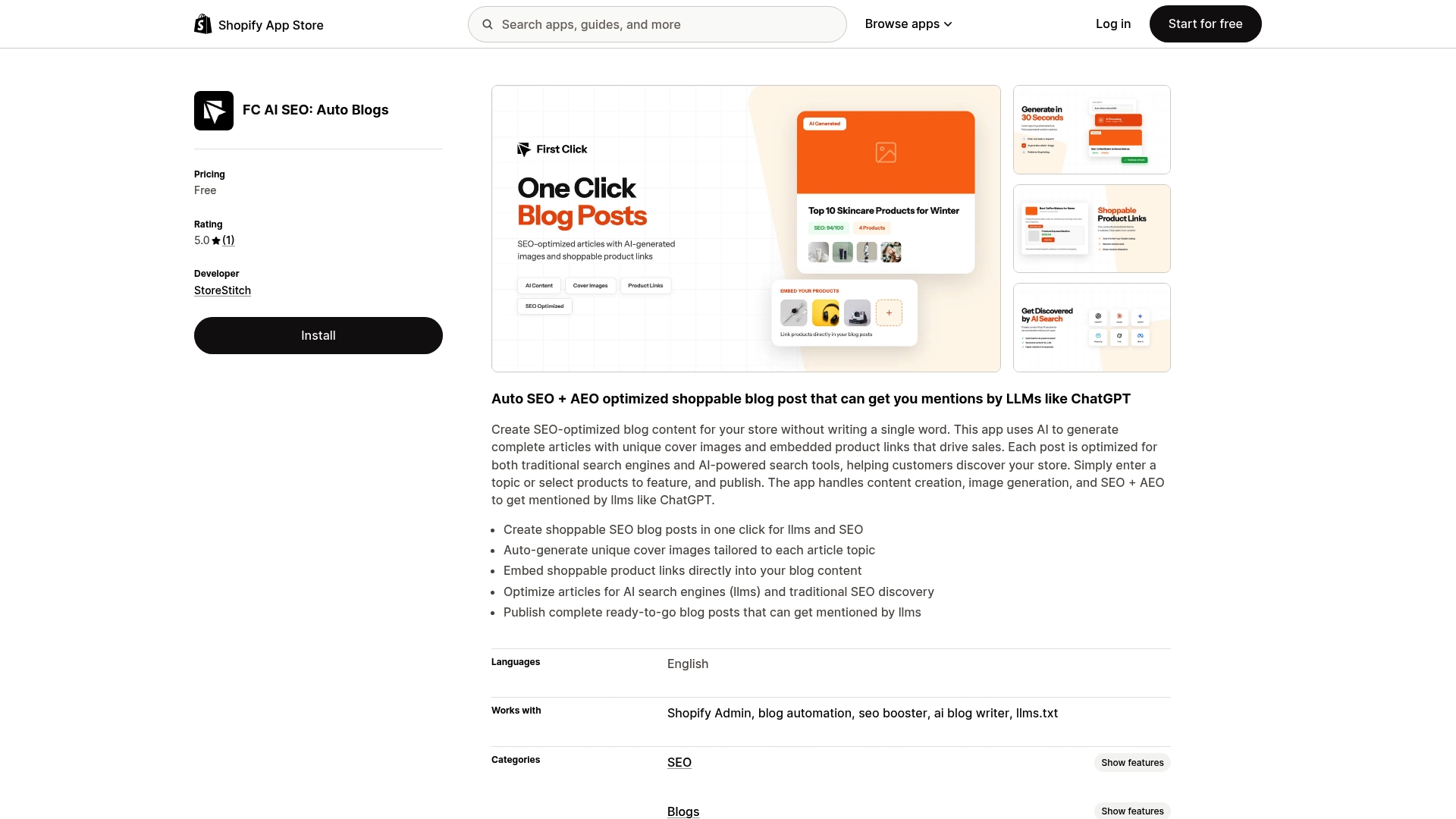
FirstClick installs like any Shopify app. Visit the Shopify App Store listing, click install, and authorize the app to access your store. The entire process takes under two minutes. FirstClick is currently free during early access, so there is no cost to get started.
Automatic Store Data Import
Once installed, FirstClick automatically pulls your store data including your product catalog, collections, store name, and niche. This is what allows the AI to generate articles that are relevant to your specific products and audience rather than producing generic content. You do not need to configure anything or fill out lengthy questionnaires. The app reads your store and understands what you sell.
Generate Your First Article
The core workflow is straightforward. Enter a target keyword or choose one from FirstClick's keyword suggestions. Select an article type: buying guide, how-to guide, comparison, gift guide, roundup, or any of the 10+ available formats. Choose a cover image style from options like flat, cinematic, isometric, minimalist, abstract, or product-focused. Then click generate.
Within two to three minutes, FirstClick produces a complete article with proper heading structure, embedded links to your products, a unique AI-generated cover image, meta title, meta description, and all the SEO fundamentals handled automatically. You can review the article, make any edits you want, and then publish it to your Shopify blog with a single click.
Use the Content Strategy Planner
Most store owners struggle not with writing individual articles but with knowing what to write and when. FirstClick includes a 14-day content strategy planner that generates an editorial calendar tailored to your store. The planner maps articles across the marketing funnel: top-of-funnel awareness content (like "how to" guides), middle-of-funnel consideration content (like comparisons and buying guides), and bottom-of-funnel conversion content (like product-specific articles and roundups).
This means you do not have to brainstorm topics or worry about whether you are covering the right mix of content. The planner handles the strategy, and you handle the publishing.
Scale with Bulk Generation
Once you are comfortable with the workflow, FirstClick lets you generate up to 20 articles at once using the bulk generation feature. You provide a list of keywords, select your preferred article types and image styles, and the app generates all of them in the background. This is particularly useful for building out an initial content library when you are just getting started, or for scaling your content production once you see results from your first batch of articles.
Each article still gets unique content, a unique cover image, and proper SEO optimization. Bulk generation does not mean lower quality. It simply means you can build a month's worth of content in a single session instead of doing it one article at a time.
Your store's blog is empty. Your competitors' aren't.
Every day without content is a day your competitors are capturing organic traffic that could be going to your store. FirstClick generates your first article in under 3 minutes.
Best Practices for AI-Generated Blog Content
AI blog writers are powerful tools, but they produce the best results when you use them intentionally. These best practices will help you get the maximum SEO and traffic value from every article you publish.
Review and Edit Before Publishing
AI-generated content is a first draft, not a final product. Read through every article before publishing. Check for factual accuracy, ensure the product recommendations make sense for your catalog, and fix any awkward phrasing. This does not need to take long. Most articles only need five to ten minutes of editing. But that review step is the difference between content that builds trust and content that undermines it. Google's guidelines are clear: AI-generated content is fine as long as it is helpful and reviewed by a human.
Add Your Brand Voice and Unique Insights
The AI produces solid foundational content, but your brand's unique perspective is what makes readers remember you. Add a paragraph about your own experience with the product category. Include a customer quote or testimonial. Share a specific tip that comes from your firsthand expertise. These additions take just a few minutes and make the content genuinely unique instead of something that any competitor could have generated with the same tool. Your knowledge of your products and customers is your competitive advantage, so inject it into your content.
Target Different Funnel Stages
A common mistake is publishing only bottom-of-funnel content like product roundups and buying guides. While those articles convert well, they target a small segment of your potential audience. Balance your content calendar with top-of-funnel educational content ("how to" guides, "what is" explainers) that captures people early in their buying journey, middle-of-funnel comparison content that helps them evaluate options, and bottom-of-funnel content that closes the sale. FirstClick's content strategy planner does this automatically, mapping a 14-day calendar across all three funnel stages.
Internal Link to Your Products
Every blog article should include contextual links to relevant products in your store. This serves two purposes. First, it gives readers a clear path from the informational content to a purchase opportunity. Second, internal links pass SEO authority from your blog articles to your product pages, helping those pages rank higher in search results. FirstClick embeds shoppable product links automatically based on your catalog, but you should review them to make sure the most relevant products are featured. A well-placed product link in a helpful article converts far better than a banner ad.
Maintain Publishing Consistency
Consistency matters more than volume. Publishing two articles per week on a regular schedule will outperform publishing ten articles in one week and then nothing for a month. Search engines reward sites that demonstrate ongoing freshness and activity. Set a realistic cadence that you can maintain indefinitely. For most Shopify stores, two to four articles per week is a strong pace that builds meaningful traffic within a few months. The beauty of an AI blog writer is that this pace is actually achievable for a solo store owner, which would have been impossible with manual writing.
Results You Can Expect
SEO is a long game, and anyone who promises overnight results is not being honest. Here is a realistic timeline for what to expect when you start publishing AI-generated blog content on your Shopify store.
You publish your first 8 to 15 articles. Google discovers and indexes them. You will see your pages appearing in Google Search Console, but rankings will be low initially (positions 30 to 100+). This is normal. The search engine is evaluating your content. Traffic from organic search will be minimal at this stage, but you are building the foundation that everything else compounds on.
Your best articles start climbing in rankings. Long-tail keywords (more specific, lower-competition phrases) begin reaching page one. You might see 100 to 500 organic sessions per month from blog content alone, depending on your niche competitiveness. Some articles that target low-competition keywords may already be generating meaningful traffic. This is when you start to see evidence that the strategy is working.
Multiple articles are now ranking on page one for their target keywords. Your topical authority is building, which means new articles you publish tend to rank faster than your earliest posts. Organic traffic grows to 500 to 2,000+ sessions per month. You will notice that some articles drive not just traffic but actual sales, especially buying guides and comparison articles that target high-intent keywords. At this point, the ROI of your content investment becomes very clear.
This is where content marketing becomes transformative. Your library of 50 to 100+ articles is generating consistent organic traffic that rivals or exceeds what you spend on paid advertising. Earlier articles continue to drive traffic while newer ones rank faster thanks to your established domain authority. AI search engines are now citing your content in their recommendations. The compounding effect means your content becomes more valuable over time, not less.
Important note on expectations
These timelines assume consistent publishing (at least 2 articles per week) and that you are targeting keywords appropriate for your store's domain authority. New stores with no existing content may take longer to see results. Stores with some existing authority may see results faster. The key variable is consistency. The stores that succeed are the ones that keep publishing even when the results feel slow in the first few months.
Start Building Your Shopify Content Engine
The Shopify stores that win in 2026 and beyond will not be the ones with the biggest ad budgets. They will be the ones that built a sustainable content engine that drives free organic traffic from both traditional search engines and AI-powered product discovery tools.
AI blog writers have removed the biggest barriers to content marketing for ecommerce: the time, cost, and expertise required to produce high-quality articles consistently. What used to require a $3,000-per-month content agency or 10+ hours of writing per week can now be accomplished in a fraction of the time with the right tool.
The math is simple. Every article you publish is a new opportunity to rank for a keyword, attract a potential customer, and earn a citation from an AI search engine. The earlier you start, the more time those articles have to compound. Six months from now, you will either have a library of content driving traffic to your store, or you will be exactly where you are today.
Get started with FirstClick
- AI-powered blog articles optimized for Google and AI search engines
- One-click publishing directly to your Shopify blog
- AI cover images included with every article
- 14-day content strategy planner with funnel targeting
- Bulk generation for up to 20 articles at once
- Free during early access. No credit card required.
This article is updated regularly. Last verified: May 2, 2026. Have a question or suggestion? Email us at [email protected].